
Walk into a motorcycle parts counter and ask for a chain replacement, and the first question back will probably be: "Standard, O-ring, or X-ring?" The answer matters — it affects how long the chain lasts, how often you'll lubricate it, how much power it consumes, and how much you'll pay. This guide breaks down the three motorcycle chain types, when to use each, and what to expect from real-world service life.
The Three Chain Types
All modern motorcycle chains use the same basic roller-and-pin design — what differs is whether the joints between pins and bushings are sealed, and how that seal is shaped.
- Standard (non-sealed) chain: no rubber seals between the pins and bushings. Lubricant flows in and out freely — meaning frequent cleaning and re-lubing is required. Cheapest, lightest, and lowest friction loss, but shortest service life under street use.
- O-ring chain: small rubber O-shaped seals trap lubricant between each pin and bushing. The lubricant stays in the joint for the chain's life. Service intervals stretch out, friction loss is slightly higher than non-sealed, and lifespan is significantly longer.
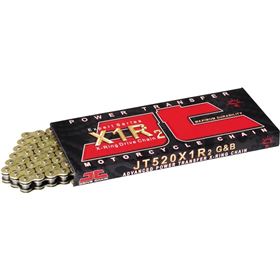
- X-ring chain: the seal is X-shaped (four contact points instead of two). Lower friction than an O-ring while providing a tighter seal. Longer service life, higher cost, and currently the standard for high-performance street motorcycles.
Head-to-Head: X-Ring vs O-Ring
For most modern street and adventure bikes, the practical choice comes down to O-ring vs X-ring. Here's how they compare.
| O-Ring Chain | X-Ring Chain | |
|---|---|---|
| Seal Shape | Round cross-section | X-shaped cross-section with four contact points |
| Friction Loss | Slightly higher than non-sealed; loses some torque to chain drag | Lower than O-ring at same load; better power transfer |
| Service Life (typical) | 12,000–20,000 miles depending on bike and maintenance | 15,000–25,000+ miles depending on bike and maintenance |
| Lubrication Schedule | External lube every 500–1,000 miles to protect O-rings | Same external schedule; internal lubricant lasts longer due to better seal |
| Cost (typical pricing) | Lower — usually 20–30% cheaper than equivalent X-ring | Higher — premium for the seal design and tighter manufacturing tolerances |
| Best Use Case | Cruisers, commuters, lower-power bikes, budget-conscious riders | Sport, sport-touring, ADV, higher-power bikes where chain efficiency matters |
When to Pick Each Type
The right chain depends on the bike, the riding, and your maintenance discipline.
- Track-only bike (no street miles) — Standard (non-sealed) chain: lightest, lowest friction. Replaced often anyway, so sealing isn't worth the friction loss. Race teams typically run non-sealed and inspect frequently.
- Daily commuter on a cruiser — O-Ring chain: sufficient sealing for moderate-power applications. Saves money over X-ring without much practical downside. Pair with a quality OEM-style cruiser sprocket set.
- Sport, sport-touring, or ADV — X-Ring chain: better seal under high load combined with lower friction makes this the standard choice for modern liter-class and ADV bikes. Worth the premium on bikes that make real power.
- Owner who hates chain maintenance — X-Ring chain: longest service intervals. Still needs external lubrication, but the internal grease is sealed for the chain's life, so internal lubrication is one less worry.
Maintenance: All Chains Need Care
Even sealed chains need external lubrication and regular inspection. Here's the basic schedule.
- Every 500–1,000 miles (or after riding in rain): clean the chain with a chain-specific cleaner, then apply chain lubricant. Wait 5 minutes for solvent to evaporate before riding.
- Every oil change: check chain tension and rear wheel alignment. Adjust per your owner's manual.
- Every 2,000–3,000 miles: inspect for stretched links, kinked links, missing O-rings or X-rings, and excessive sprocket wear.
- Replace when: the chain reaches the wear-limit length specified in your service manual, or any link can't be straightened, or the chain is making clicking/popping noises that don't resolve with lubrication.
Shop Chains and Sprocket Kits
Whether you're looking for a budget O-ring chain for a commuter or a premium X-ring for a sportbike, we stock JT Sprockets, DID, RK, and other major brands. Most of our chain inventory is available as chain-and-sprocket kits, which is the recommended replacement approach. Browse our motorcycle parts catalog or call ahead with your bike's year, make, and model for fitment confirmation.
Safety Notice & Disclaimer
This article is provided for general informational purposes only. Chain specifications, recommended types, and replacement intervals vary by motorcycle model, riding style, and maintenance habits. Always consult your owner's manual for the correct chain pitch and length, and replace chains, sprockets, and links per the manufacturer's torque and tension specifications.
Drive chain failure at speed can cause loss of control. Have all chain work performed or inspected by a qualified motorcycle technician if you are not confident in the procedure. Chaparral Motorsports is not responsible for injury, damage, or loss arising from the use of products discussed in this article.
