
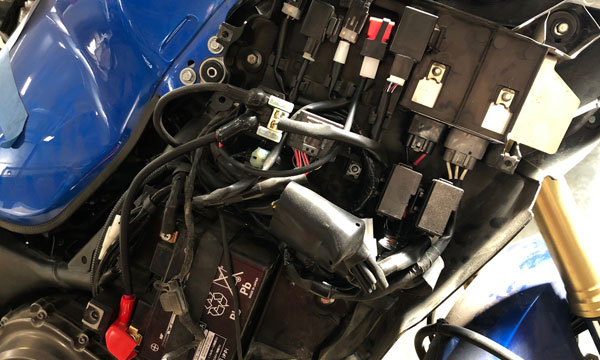
It happens at the worst possible time — you thumb the starter and the bike sputters, clicks, or just falls silent. Modern motorcycles have more intricate wiring than the bikes of 20 years ago, and chasing an electrical gremlin can feel daunting if you don't know where to start. The good news: most no-start and intermittent electrical problems trace back to a handful of components, and you can narrow the culprit down in under an hour with a multimeter and a service manual. Here's how to diagnose motorcycle electrical issues, component by component.
Main Fuse
Your bike's entire electrical system relies on the main fuse. A bad main fuse can cause anything from a complete no-start to intermittent dropouts that feel like a battery problem.
Things that knock out a main fuse: an old or corroded fuse holder, vibration loosening the spade connectors, a short circuit upstream, or moisture intrusion. The fuse itself can look fine through the glass and still be cracked or making poor contact. Pull it, inspect both ends, and bench-test continuity with a multimeter on the resistance setting — a good fuse reads near zero ohms. Replace with the same amperage rating spelled out in your service manual; oversizing the fuse is a fire risk and won't fix the underlying problem.
Motorcycle Battery
The battery is the most-replaced electrical part on motorcycles, and the easiest to test definitively.
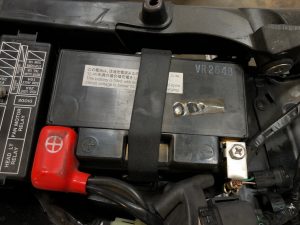
Set your multimeter to DC voltage and probe the terminals with the bike off. A fully charged 12V motorcycle battery should read 12.6–12.8 volts. Below 12.4V and you've got a partial discharge; below 12.0V the battery is heavily discharged and may not start the bike. Below about 10.5V under load, the battery is likely sulfated and won't recover even with a good charger.
Next, do a load test. Start the bike (or have it cranked over) and measure terminal voltage while the starter is engaged. If voltage collapses below 9.5V under cranking, the battery has lost capacity — replace it. If voltage stays strong but the starter still won't spin, the issue is downstream (starter relay, solenoid, or motor).
Ground Wires
Bad grounds cause weird, intermittent electrical symptoms that look like everything from a flaky battery to a failing ignition switch.
Symptoms of a bad ground include flickering lights, gauges that drop in and out, and a bike that cranks but won't start consistently. Use your service manual to identify every chassis ground point — most bikes have a main engine ground, a frame ground, and several component-specific grounds. Check each one for corrosion, loose hardware, or paint between the ring terminal and the chassis. Clean, dielectric-grease, and re-torque every suspect ground point. It's one of the cheapest fixes in motorcycle wiring, and it should be one of the first checks you make.
Rectifier / Regulator
The rectifier/regulator converts your stator's AC output into DC to charge the battery, and manages voltage so the battery isn't overcharged.
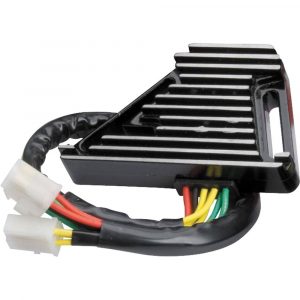
Symptoms of a failing rectifier/regulator: the battery won't stay charged, the bike runs fine and then dies on a long ride, or you measure overcharging at the battery (over 15V at idle is a red flag). To test, disconnect the rectifier/regulator and use the multimeter on the diode function. Touch the positive lead to the positive output and the negative lead to each stator input — a good unit will conduct one direction and block the other. If both directions read open, or both read short, the rectifier/regulator has failed.
Heat is the #1 killer of these units. If you've replaced one and the new one fails too, look at the charging system load (added accessories, heated grips, aux lights) and the airflow around the mounting location.
Stator
The stator is the part of your charging system that generates AC voltage from engine rotation. When it fails, your battery slowly drains while the bike runs.
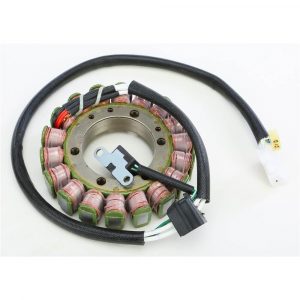
Two stator tests: (1) Resistance test — with the engine off and the stator unplugged, measure resistance between each pair of stator output wires. Compare against your service manual spec; values should match across all pairs. (2) AC output test — with the bike running at the RPM your manual specifies, measure AC voltage between each pair of stator output wires. Values should be roughly equal and within spec.
A stator with one shorted winding will produce uneven readings between pairs. A completely failed stator will read open. Replacement stators are not expensive on most bikes, but the labor to access them can be significant — confirm the diagnosis before pulling the engine cover.
Tools You'll Need
- Digital multimeter with DC voltage, AC voltage, resistance, and diode functions
- Your bike's service manual — required for ground points and component specs
- Battery tender / smart charger for recovering a discharged but healthy battery
- Dielectric grease for protecting ground points and connector pins
- Wire brush + contact cleaner for corroded terminals
Need Parts? We Carry Them.
Chaparral Motorsports stocks batteries, stators, rectifier/regulators, fuses, wiring harnesses, and electrical accessories for most major motorcycle brands. Browse our motorcycle parts or call our parts counter at 1-800-841-2960 — give us your bike's year, make, and model and we'll confirm fitment before you order.
Safety Notice & Disclaimer
This article is provided for general informational purposes only and is not a substitute for professional motorcycle service or your motorcycle's service manual. Electrical diagnostic procedures and component specifications vary by year, make, and model — always reference the factory service manual for your specific bike.
Working on motorcycle electrical systems involves risks including electric shock, burns, fire, and damage to the motorcycle. Disconnect the battery before performing component-level diagnostics. Wear eye protection. Never bypass fuses or substitute higher-amperage fuses than the manufacturer specifies. If you are not confident in any procedure, have the work performed by a qualified motorcycle technician. Chaparral Motorsports is not responsible for injury, damage, or loss arising from the use of products or procedures discussed in this article.
